





You must be logged in to post a review.
ID: 25198
Categories: Peptides for Research, Sexual Health & Hormonal Peptides
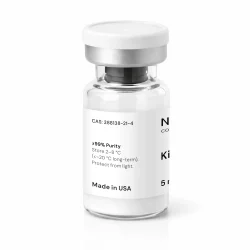
Kisspeptin 5mg
Coming soon
Brand: NOVERA COMPOUNDS
Strength: 5mg
CAS: 388138-21-4
Chemical Formula: C₆₃H₈₃N₁₇O₁₄
Molecular weight: 1302.4 g/mol
Peptide Sequence: Tyr-Asn-Trp-Asn-Ser-Phe-Gly-Leu-Arg-Phe-NH₂
Synonyms: Metastin (45–54), KP-10
Storage: Store 2–8 °C (≤–20 °C long-term). RT exposure during transport acceptable. Protect from light.
Shelf life: 24 months from the manufacturing date.
This product isn't available in your region. Please contact our sales team to explore available alternatives.
Log in or sign up to get notified when this product becomes available.
Log In / Sign UpKisspeptin is a naturally occurring neuropeptide involved in reproductive hormone signaling. Research suggests that it may influence gonadotropin release and reproductive axis regulation, primarily through activation of hypothalamic pathways that control luteinizing hormone and follicle-stimulating hormone secretion.
Disclaimer : Available as lyophilized (freeze-dried) powder for laboratory and in vitro research applications. Reconstitution solution is not included in the pack.
Purity ≥99%
Made in USA
Research Use Only
Fast Shipping
The Novera Compounds Advantage
Made in the USA
Manufactured in the United States under controlled standards. Reliable production. Dependable supply. No overseas uncertainty.
High Purity — 99% or Better
Every batch meets ≥99% purity specifications and is verified by independent third-party laboratory testing. Clean. Consistent. Documented.
Advanced Lyophilized Stability
Carefully lyophilized for structural integrity and easier handling. No cold shipping required. No dry ice. No complications.
Designed for Research
Ideal for scientific study, analytical testing, and research workflows where consistency and quality matter most.
Smart Pricing. Real Value.
High purity. USA-made. Third-party tested. Priced to make sense.
Everything in One Order
Already ordering other products? Add peptides to the same shipment. One vendor. One contact person. Simple.
Product Description
Specifications
Description
Strength: 5mg
CAS: 388138-21-4
Chemical Formula: C₆₃H₈₃N₁₇O₁₄
Molecular weight: 1302.4 g/mol
Peptide Sequence: Tyr-Asn-Trp-Asn-Ser-Phe-Gly-Leu-Arg-Phe-NH₂
Synonyms: Metastin (45–54), KP-10
Storage: Store 2–8 °C (≤–20 °C long-term). RT exposure during transport acceptable. Protect from light.
Shelf life: 24 months from the manufacturing date.
Kisspeptin (5mg) About This Product
Kisspeptin (5mg) is a synthetic decapeptide derived from the KISS1 gene product and is widely used in laboratory research on reproductive physiology and neuroendocrine regulation. The kisspeptin peptide functions as an agonist of the GPR54 receptor (also known as KISS1R), a G protein–coupled receptor (GPCR) that plays a central role in gonadotropin secretion and reproductive neuroendocrine control in controlled experimental systems.
Kisspeptin-10 (Kp-10) represents the bioactive C-terminal decapeptide fragment (Tyr–Asn–Trp–Asn–Ser–Phe–Gly–Leu–Arg–Phe), with a molecular weight of 1,302 Da. This short-form variant is the research-grade sequence most commonly employed in studies of GPR54 receptor pharmacology and hypothalamic-pituitary-gonadal (HPG) axis signaling.
The product is supplied as a high-purity, lyophilized powder in a sealed research vial to support accurate dosing, stability, and reproducibility across experimental models.
Kisspeptin (5mg) Key Features and Benefits
- GPR54 (KISS1R) Receptor Agonist: Receptor-specific probe for neuroendocrine signaling
- Decapeptide Structure (Kp-10): Bioactive C-terminal fragment optimized for receptor activation
- Gq/11-Coupled Signaling Activation: Engages PLC, calcium mobilization, and kinase cascades
- GnRH Neuron Modulation Tool: Interrogates HPG axis coordination and gonadotropin release
- High-Purity Research Grade: Suitable for analytical and preclinical applications
- Lyophilized 5 mg Formulation: Precise reconstitution and experimental flexibility
This is compatible with cell-based assays, tissue studies, and animal models, and is frequently selected by laboratories that buy Kisspeptin peptide
Kisspeptin (5mg) Mechanism & Research Applications
Kisspeptin functions as an agonist of the GPR54 (KISS1R) receptor, initiating Gq/11-mediated intracellular signaling essential for neuroendocrine regulation. Upon receptor activation, kisspeptin engages phospholipase C (PLC), leading to the generation of inositol trisphosphate (IP₃), intracellular calcium mobilization, and activation of downstream kinase pathways. These cascades drive transcriptional responses that modulate gonadotropin-releasing hormone (GnRH) neuron activity and shape gonadotropin secretion patterns in controlled laboratory settings.
In research contexts, kisspeptin serves as a selective molecular probe to investigate GPR54-dependent signaling, GnRH neuron physiology, and the regulatory logic of the hypothalamic-pituitary-gonadal (HPG) axis.
Primary Research Domains
- GnRH Neuron Physiology & Gonadotropin Dynamics: Investigation of GnRH neuron excitability, pulse generation, and receptor desensitization kinetics.
- HPG Axis Signaling & Feedback Regulation: Studies of LH/FSH release patterns and sex-steroid feedback coordination.
- Metabolic & Energy-Balance Integration: Examination of how reproductive neuroendocrine signals interface with energy homeostasis.
- Receptor Pharmacology & Second-Messenger Analysis: GPR54 binding affinity, calcium flux kinetics, kinase phosphorylation, and transcriptional output.
- Behavioral & Cognitive Signaling Paradigms: Rodent models evaluating learning, memory, and neuromodulatory effects.
- Oncology & Cell-Migration Research: Context-specific studies of tumor cell motility, adhesion, and invasion phenotypes.
- Vascular & Tissue-Specific Signaling: Investigation of endothelial, renal, and peripheral tissue GPR54 signaling dynamics.
Preclinical Research Summary
- GnRH Neuron Activation & Gonadotropin Secretion: Studies characterize firing patterns, pulse frequency, and LH/FSH release kinetics.
- HPG Axis Coordination & Reproductive Physiology: Models examine sex-steroid feedback and reproductive axis integration.
- Energy Balance & Metabolic Signaling: Research measures adiposity, energy expenditure, and nutrient-sensing pathways.
- Tumor Cell Migration & Adhesion: Preclinical oncology models assess motility and invasion markers.
- Circadian Rhythm & Neuroendocrine Timing: Interactions between kisspeptin signaling and light–dark cycle regulation.
- Learning, Memory & Cognitive Function: Behavioral paradigms assess the roles of hippocampal and cortical signaling.
- Vascular & Cardiovascular-Renal Signaling: Assessment of endothelial reactivity and tissue-specific receptor effects.
Kisspeptin (5mg) Dosing & Observed Effects in Research
Published research employs model-specific experimental dosing protocols, adjusted for species, route of administration, and study duration. Investigations span cell-based assays, tissue preparations, rodent models, and larger preclinical systems.
Observed research endpoints include:
- GnRH neuron firing rates and electrophysiological parameters
- LH and FSH secretion kinetics
- Intracellular calcium flux and IP₃ accumulation
- ERK1/2 and p38 MAPK phosphorylation
- Gene-expression changes in GnRH and gonadotropin cells
- Cell migration and invasiveness markers in tumor models
- Adiposity and energy-expenditure metrics
- Behavioral performance in learning and memory paradigms
All findings derive exclusively from controlled laboratory and preclinical animal research systems.
Kisspeptin (5mg) Storage, Safety & References
Store Kisspeptin (5mg) in its lyophilized form at 2–8°C, protected from light and moisture. Reconstitution should be performed using sterile laboratory techniques, with care taken to minimize freeze–thaw cycles.
This product is intended for use by qualified research professionals only. Laboratories that order Kisspeptin peptide are responsible for compliance with institutional safety, handling, and disposal guidelines.
References
https://academic.oup.com/jcem/article-abstract/90/12/6609/2837183
https://pubmed.ncbi.nlm.nih.gov/18775460/
https://academic.oup.com/endo/article/149/9/4605/2455771
https://pmc.ncbi.nlm.nih.gov/articles/PMC4063702/
https://www.frontiersin.org/journals/endocrinology/articles/10.3389/fendo.2022.925206/full
https://pmc.ncbi.nlm.nih.gov/articles/PMC4678402/
Compliance Notice
This product is intended for laboratory research use only and is not approved for human or veterinary use.
Reviews
There are no reviews yet.