




You must be logged in to post a review.
ID: 25035
Categories: Peptides for Research, Weight Loss & Metabolic Peptides
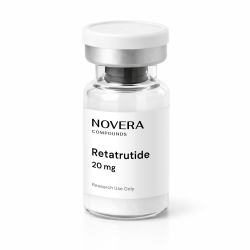
Retatrutide 20mg
Brand: NOVERA COMPOUNDS
Strength: 20mg
CAS: 2381089-83-2
Chemical Formula: C₂₂₁H₃₄₂N₄₆O₆₈
Molecular weight: 4845.444 g/mol
Peptide Sequence: Tyr-{Aib}-Gln-Gly-Thr-Phe-Thr-Ser-Asp-Tyr-Ser-Ile-{α-Me-Leu}-Leu-Asp-Lys-{diacid-C20-gamma-Glu-(AEEA)-Lys}-Ala-Gln-{Aib}-Ala-Phe-Ile-Glu-Tyr-Leu-Leu-Glu-Gly-Gly-Pro-Ser-Ser-Gly-Ala-Pro-Pro-Pro-Ser-NH2 (Sodium salt)
Synonyms: Retatrutide acetate, LY3437943
Storage: Store 2–8 °C (≤–20 °C long-term). RT exposure during transport acceptable. Protect from light.
Shelf life: 24 months from the manufacturing date.
$175.00
Contact Us
Retatrutide is a synthetic tri-agonist peptide with activity at GLP-1, GIP, and glucagon receptors in metabolic research. It enables investigation of appetite regulation, glucose homeostasis, and energy balance through integrated endocrine signaling across coordinated metabolic receptor pathways.
Disclaimer : Available as lyophilized (freeze-dried) powder for laboratory and in vitro research applications. Reconstitution solution is not included in the pack.
Purity ≥99%
Made in USA
Research Use Only
Fast Shipping
Explore Other High-Purity Peptides

BPC-157 15mg

PE-22-28 10mg
$ 63.00The Novera Compounds Advantage
Made in the USA
Manufactured in the United States under controlled standards. Reliable production. Dependable supply. No overseas uncertainty.
High Purity — 99% or Better
Every batch meets ≥99% purity specifications and is verified by independent third-party laboratory testing. Clean. Consistent. Documented.
Advanced Lyophilized Stability
Carefully lyophilized for structural integrity and easier handling. No cold shipping required. No dry ice. No complications.
Designed for Research
Ideal for scientific study, analytical testing, and research workflows where consistency and quality matter most.
Smart Pricing. Real Value.
High purity. USA-made. Third-party tested. Priced to make sense.
Everything in One Order
Already ordering other products? Add peptides to the same shipment. One vendor. One contact person. Simple.
Product Description
Specifications
Description
Strength: 20mg
CAS: 2381089-83-2
Chemical Formula: C₂₂₁H₃₄₂N₄₆O₆₈
Molecular weight: 4845.444 g/mol
Peptide Sequence: Tyr-{Aib}-Gln-Gly-Thr-Phe-Thr-Ser-Asp-Tyr-Ser-Ile-{α-Me-Leu}-Leu-Asp-Lys-{diacid-C20-gamma-Glu-(AEEA)-Lys}-Ala-Gln-{Aib}-Ala-Phe-Ile-Glu-Tyr-Leu-Leu-Glu-Gly-Gly-Pro-Ser-Ser-Gly-Ala-Pro-Pro-Pro-Ser-NH2 (Sodium salt)
Synonyms: Retatrutide acetate, LY3437943
Storage: Store 2–8 °C (≤–20 °C long-term). RT exposure during transport acceptable. Protect from light.
Shelf life: 24 months from the manufacturing date.
Retatrutide 20mg - About This Product
Retatrutide 20mg is a research-grade synthetic peptide consisting of a 39-amino-acid core with a C20 fatty diacid moiety. The molecular formula is C₂₂₁H₃₄₂N₄₆O₆₈, with a molar mass of 4731 g/mol and an approximate molecular weight of ~4992.6 Da (accounting for the fatty acid modification).
It comes as a lyophilized powder at ≥98% purity. Aside from the 20 mg vial, researchers may also buy Retatrutide in a Retatrutide 10 mg vial.
Retatrutide for research has been studied for its effects on metabolic regulation, energy balance, nutrient signaling, and multi-pathway hormone activity, strictly in laboratory environments.
Retatrutide 20mg - Key Features and Benefits
- High-purity (≥98%) retatrutide peptide suitable for controlled laboratory studies
- Supplied as a stable lyophilized powder for long-term storage and flexible reconstitution
- Available in a 20mg format; also offered as a Retatrutide 10 mg vial for dose-range experiments
- Has been studied for its triple-agonist activity on GIP, GLP-1, and glucagon-related pathways
- Useful for metabolic, endocrine, and receptor-signaling research
- Packaged in sterile, sealed vials to maintain sample integrity
- Compatible with standard buffers such as sterile water or PBS (pH 7.4)
Retatrutide 20mg - Mechanism & Research Applications
Retatrutide is of interest due to its ability to activate multiple metabolic receptors simultaneously. Research has shown:
Receptor Potency (EC₅₀ values)
- GIP receptor: ~0.0643 nM (highest potency)
- GLP-1 receptor: ~0.775 nM
- Glucagon receptor: ~5.79 nM
This balanced activation profile allows researchers to examine:
- Energy balance and glucose homeostasis
- Gastric emptying delay and nutrient handling
- Insulin secretion dynamics in response to glucose
- Body-composition regulation, including fat-related signaling
- Lipolysis and hepatic glucose output in metabolic models
- Multi-pathway co-agonist interactions and receptor synergy
Retatrutide for research is widely used in in vitro, in vivo, and early-phase trial models to study complex hormonal signaling patterns without implying therapeutic outcomes.
Retatrutide 20mg - Dosing & Observed Effects in Research
Typical Research Dose Ranges
- Weekly doses between 4 mg and 12 mg in early-phase human studies
- Common study groups: 1 mg, 4 mg, 8 mg, and 12 mg
- The 20mg formulation allows researchers to prepare custom aliquots and mid-range dosing
Dose-Escalation Protocols
Research protocols often use stepwise escalation, such as:
- 2mg → 4mg → 8mg → 12mg weekly
- Some extended studies test intermediate or exploratory doses
Observed Research Findings
Across controlled settings, investigators have measured:
- Changes in metabolic biomarkers
- Modulation of receptor activity
- Alterations in energy expenditure and glucose signaling
- Shifts in appetite-related pathways
These outcomes remain specific to laboratory and early-phase research and do not imply therapeutic use.
Adverse Events Noted in Studies
Retatrutide has been associated with dose-dependent gastrointestinal side effects in Phase 2 and early Phase 3 trials:
- Nausea: Most frequently reported GI effect; increased with dose escalation; generally mild-to-moderate and transient
- Vomiting: Less common than nausea; primarily during dose escalation phases
- Diarrhea: Reported in escalation cohorts; manageable with dose adjustment
- Constipation: Documented at higher doses (8–12 mg); dose-dependent
- Abdominal discomfort: Mild-to-moderate; resolved after stabilization
- Key Finding: With proper dose escalation protocols (starting at 1 mg and titrating over 16–20 weeks), 85–90% of trial participants completed the full protocol without discontinuation. Most side effects resolved within 2–4 weeks after reaching a stable dose.
Retatrutide 20mg - Storage, Safety & References
Storage (Lyophilized)
- Store unopened vials at 2–8°C for routine use; for long-term archival storage beyond 24 months, storage at –20°C is acceptable
- Protect from light and moisture
- Keep vial sealed until use
Reconstitution
- Reconstitute using sterile water or PBS (pH 7.4)
- Typical stock: 1 mg/mL
- Gently swirl; avoid vigorous shaking
Stability
- At 4°C: Use within 24–48 hours
- At –20°C: Stable for up to 2 weeks when aliquoted
- Avoid repeated freeze–thaw cycles
Safety
- Intended only for trained laboratory personnel
- Use gloves, sterile tools, and eye protection
- Dispose of unused material according to institutional chemical-safety protocols
References
https://pubmed.ncbi.nlm.nih.gov/40291085/
https://www.nature.com/articles/s41591-024-03018-2
https://pmc.ncbi.nlm.nih.gov/articles/PMC10844714/
https://pubmed.ncbi.nlm.nih.gov/38367045/
https://pmc.ncbi.nlm.nih.gov/articles/PMC12304053/
Compliance Notice
This product is intended for laboratory research use only and is not approved for human or veterinary use.
Reviews
There are no reviews yet.