


You must be logged in to post a review.
ID: 25097
Categories: Brain, Cognitive & Nootropic Peptides, Peptides for Research
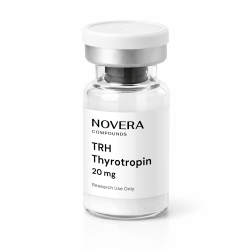
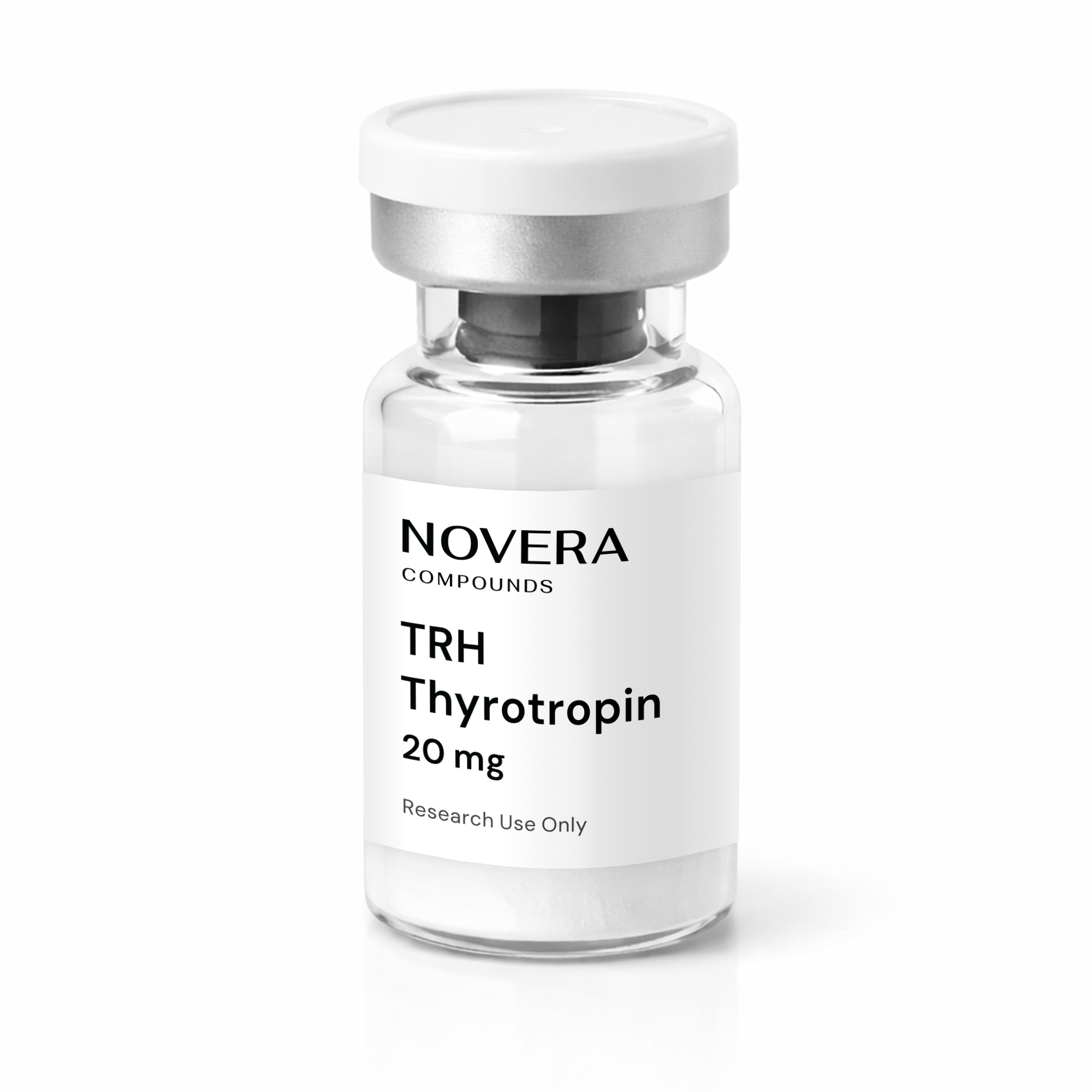
TRH Thyrotropin 20mg
Coming soon
Brand: NOVERA COMPOUNDS
Strength: 20mg
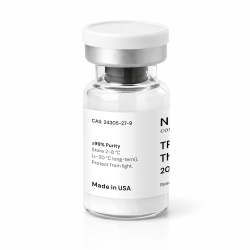
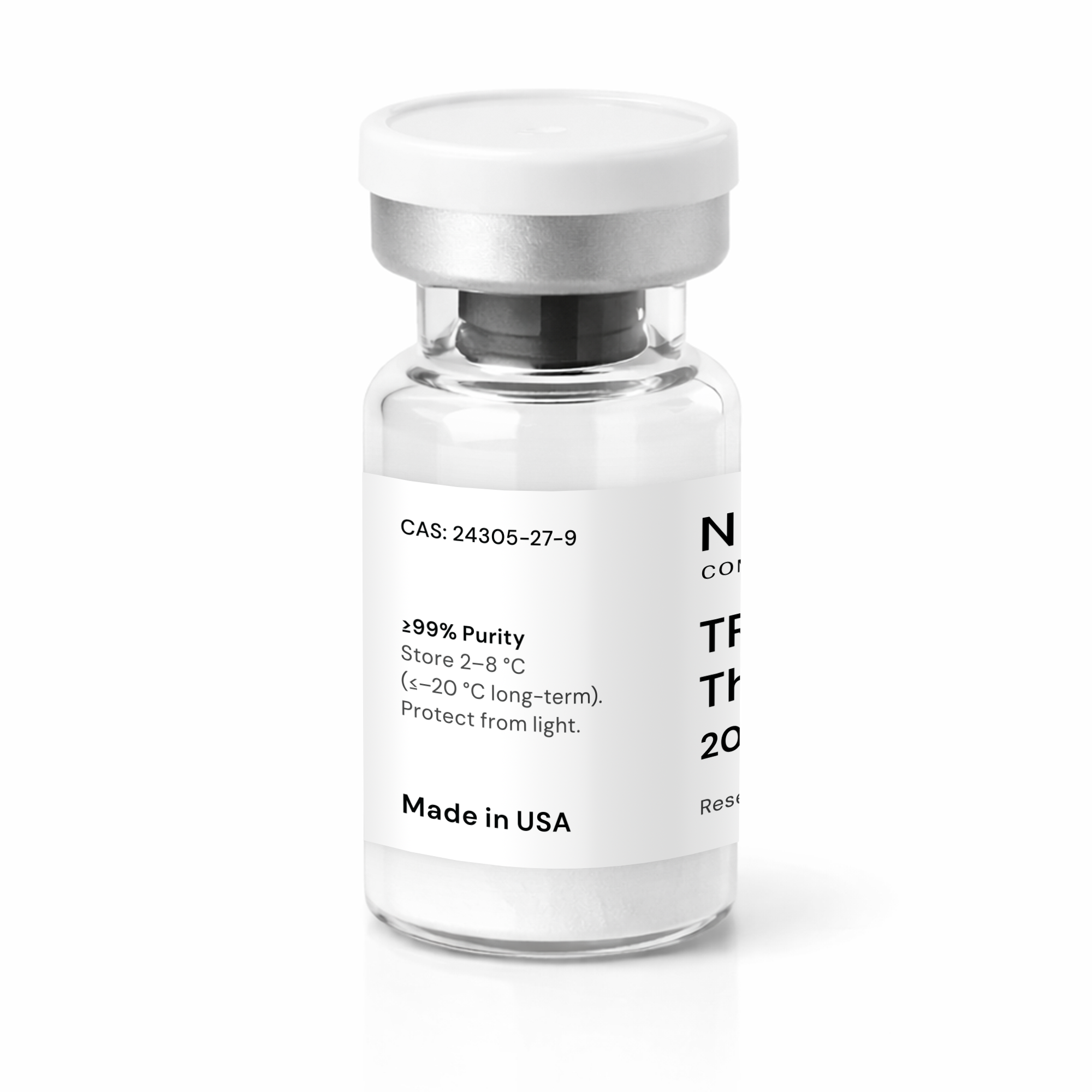
CAS: 24305-27-9
Chemical Formula: C₁₆H₂₂N₆O₄
Molecular weight: 362.38 g/mol
Peptide Sequence: Pyr-His-Pro-NH2
Synonyms: Protirelin
Storage: Store 2–8 °C (≤–20 °C long-term). RT exposure during transport acceptable. Protect from light.
Shelf life: 24 months from the manufacturing date.
This product isn't available in your region. Please contact our sales team to explore available alternatives.
Log in or sign up to get notified when this product becomes available.
Log In / Sign UpTRH is a synthetic form of thyrotropin-releasing hormone studied in neuroendocrine research. Research suggests it may stimulate thyroid-stimulating hormone release, supporting investigations into the regulation of the hypothalamic–pituitary–thyroid axis. Its use enables controlled study of endocrine feedback loops, thyroid-related signaling pathways, and neurohormonal coordination mechanisms.
Disclaimer : Available as lyophilized (freeze-dried) powder for laboratory and in vitro research applications. Reconstitution solution is not included in the pack.
Purity ≥99%
Made in USA
Research Use Only
Fast Shipping
The Novera Compounds Advantage
Made in the USA
Manufactured in the United States under controlled standards. Reliable production. Dependable supply. No overseas uncertainty.
High Purity — 99% or Better
Every batch meets ≥99% purity specifications and is verified by independent third-party laboratory testing. Clean. Consistent. Documented.
Advanced Lyophilized Stability
Carefully lyophilized for structural integrity and easier handling. No cold shipping required. No dry ice. No complications.
Designed for Research
Ideal for scientific study, analytical testing, and research workflows where consistency and quality matter most.
Smart Pricing. Real Value.
High purity. USA-made. Third-party tested. Priced to make sense.
Everything in One Order
Already ordering other products? Add peptides to the same shipment. One vendor. One contact person. Simple.
Product Description
Specifications
Description
Strength: 20mg
CAS: 24305-27-9
Chemical Formula: C₁₆H₂₂N₆O₄
Molecular weight: 362.38 g/mol
Peptide Sequence: Pyr-His-Pro-NH2
Synonyms: Protirelin
Storage: Store 2–8 °C (≤–20 °C long-term). RT exposure during transport acceptable. Protect from light.
Shelf life: 24 months from the manufacturing date.
TRH Thyrotropin (20mg) – About This Product
TRH (Thyrotropin-Releasing Hormone) 20 mg is supplied as a research-grade lyophilized powder intended for use in regulated laboratory environments only. TRH is also known as protirelin and consists of the sequence pyroglutamyl-histidyl-proline amide (pGlu–His–Pro–NH₂).
The 20 mg vial format supports laboratories conducting repeated assays, receptor-level signaling studies, and extended experimental workflows that require consistent peptide availability. Qualified laboratories that buy TRH peptide commonly employ it in neuroendocrine, autonomic, and central nervous system signaling research.
TRH Thyrotropin (20mg) – Key Features and Benefits
TRH (Thyrotropin-Releasing Hormone) is a compact hypothalamic neuropeptide endogenously produced by parvocellular neurons of the hypothalamus. It plays a central role in hypothalamic–pituitary communication and is distributed across multiple regions of the central nervous system, including the cerebellum, brainstem, and autonomic nuclei.
In laboratory research, the TRH peptide is widely used as a mechanistic probe for studying neuroendocrine signaling, G protein–coupled receptor (GPCR) activation, and second-messenger cascades. Its short signaling duration and well-defined receptor coupling make it a reference compound for both endocrine and neuroscience research models.
- Amino acid sequence: pGlu–His–Pro–NH₂ (also written Pyr–His–Pro)
- Peptide length: Tripeptide
- Molecular formula: C₁₆H₂₂N₆O₄
- Molecular weight: 362.39 g/mol
- PubChem CID: 638678
- CAS number: 24305-27-9
TRH Thyrotropin (20mg) – Mechanism & Research Applications
The TRH peptide binds to the TRH receptor (TRHR), a Gq/11-coupled GPCR expressed on multiple pituitary and neuronal cell types. Receptor activation stimulates phospholipase C (PLC), leading to the formation of inositol triphosphate (IP₃) and diacylglycerol (DAG).
These second messengers drive intracellular calcium release and activation of protein kinase C (PKC). Through this shared signaling cascade, TRH mediates:
- Thyrotropin (TSH) release from thyrotroph cells
- Prolactin release from lactotroph cells
This dual endocrine action explains why TRH is a valuable tool for studying multiple pituitary cell populations using a single, well-defined signaling mechanism.
TRH is supplied exclusively for laboratory research and is commonly used in:
- Neuroendocrine signaling models: Hypothalamic–pituitary axis studies examining receptor sensitivity, hormone release kinetics, and feedback regulation.
- Cerebellar synaptic plasticity research: Investigation of long-term depression (LTD), motor learning, and AMPA receptor trafficking in cerebellar circuits.
- Autonomic network physiology: Studies of respiratory drive, cardiovascular regulation, and brainstem reflex integration.
- Analog comparison studies: Direct comparison of TRH with stabilized analogs such as taltirelin to assess duration of action and resistance to enzymatic degradation.
TRH Thyrotropin (20mg) – Dosing & Observed Effects in Research
All dosing values below reflect preclinical and in vitro research only:
- Intravenous injection: 0.1–40 μg
- Intravenous infusion: ~0.2 μg/hour
- Intraperitoneal (animal studies): 0.1–1.0 mg/kg
- In vitro assays: Nanomolar to micromolar ranges, assay-dependent
Observed effects include rapid calcium signaling, TSH and prolactin release, and modulation of neuronal excitability. Safe or effective human dosing has not been established.
TRH Thyrotropin (20mg) – Storage, Safety & References
When lyophilized or unopened:
- –80 °C: Preferred for 1+ year storage
- –20 °C: Up to 24 months
- 2–8 °C: Short-term use
Once reconstituted:
- Use sterile buffer at pH 7.2–7.4
- Store at 2–8 °C and use within 5–7 days
- May be aliquoted and frozen once at –20 °C for up to 3 months
Visual Inspection
- Clear solution is expected
- Cloudiness or discoloration may indicate degradation or contamination
Rapid degradation in biological fluids is expected due to enzymatic turnover. This rapid degradation is a key experimental consideration and explains why TRH is often compared with metabolically stabilized analogs in animal studies. Researchers must account for this property when designing dose timing, routes of administration, and the interpretation of transient signaling effects.
References
https://pubmed.ncbi.nlm.nih.gov/36147745/
https://pubmed.ncbi.nlm.nih.gov/26101376/
https://pubmed.ncbi.nlm.nih.gov/30618637/
https://pubmed.ncbi.nlm.nih.gov/9075462/
Compliance Notice
This product is intended for laboratory research use only and is not approved for human or veterinary use.
Reviews
There are no reviews yet.